
Principle of a Generator
We chose the Moving Coil (MC) principle as the foundation for the IO series cartridge design because it offers greater linearity in electrical output—derived from the mechanical movement of the stylus tip—than any other system. We investigated moving-iron, moving-magnet, strain-gauge, electret, and electrostatic generators, and even took the unusual step of purchasing a Toshiba cartridge that used an LED to generate signals from the groove; ultimately, however, we felt that refinements to the moving-coil system—as described by P.G.A.H. Voigt—would yield the best overall results.
Mechanical structure
To ensure the accurate recovery of information stored on an LP, the mechanical movement of the stylus must be precisely converted into electrical signals. Any extraneous excitation resulting from vibrations of the cartridge housing must be eliminated.
Therefore, when designing Audio Note (UK) cartridges, great attention is paid to body rigidity and structural integrity, ensuring that the mechanical structure stores the absolute minimum amount of resonant energy—energy that would otherwise degrade the signal derived from the LP being played.
The mechanical integrity of the cartridge body is a design aspect that had never been adequately addressed before; consequently, all other cartridges suffer from significant coloration caused by internal resonances and/or energy stored within their assemblies.
To achieve the incredible level of mechanical integrity required for the IO cartridge, every aspect of the body design was re-examined to minimize standing waves and eliminate any resonant air pockets within the assembly.
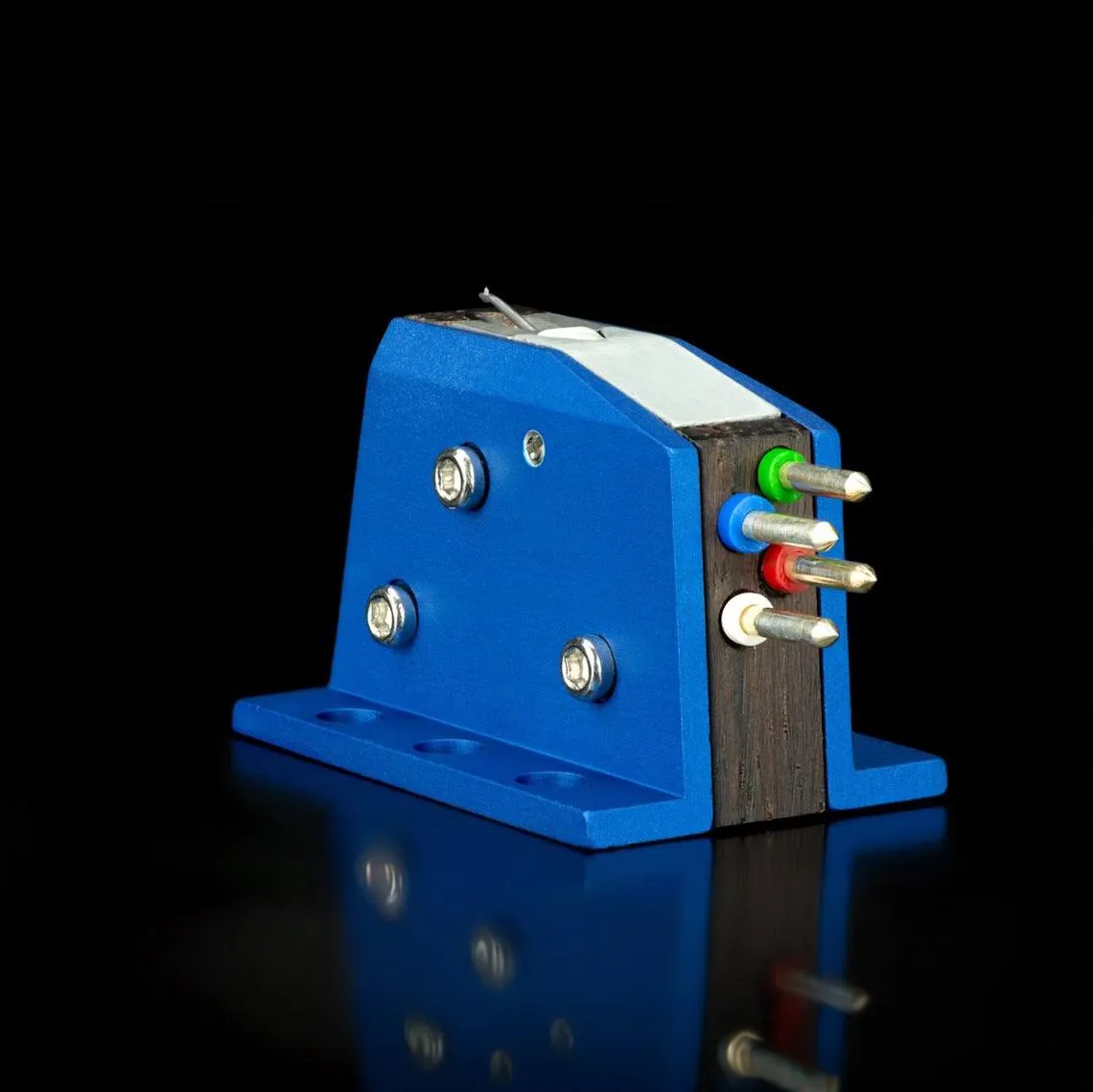
If the entire assembly cannot be securely mounted to the tonearm, the benefits of a precision-engineered mechanical assembly are lost; therefore, the mounting surface area is maximized, and up to six (6!) bolts are provided to secure the cartridge to the headshell.
magnetic circuit
Once mechanical assembly is complete, the next area requiring special attention is the magnetic circuit.
Extensive testing of various materials and configurations has established that different types of magnetic materials exert a subtle influence on the perceived quality of the final sound.
Extensive further research revealed that the optimal electromagnetic circuit is one that is electromagnetically generated. However, this requires a separate DC power supply and entails high implementation costs. This is the very system we implemented in our flagship moving-coil cartridge, IO Limited, which delivers unparalleled performance. For IO I and IO II models, however, we selected Alnico—the next-best magnetic material—while for the IO Gold, we chose a combination of Alnico and Permadure.
Cable
Given the low impedance and very low output levels involved, it is essential to minimize the number of electrical connections along the signal path and ensure the wiring itself is of the highest possible quality. Unsurprisingly, we opted for custom Audio Note (UK) 99.99% pure silver wire, running the coil wiring directly to the output terminals to eliminate all unnecessary connections.
Cantilever: materials and design
The quality of a phono cartridge depends largely on the design and construction of the cantilever. Due to defects found in one or more areas, a range of materials—including boron, beryllium, sapphire, diamond, and titanium—were investigated; ultimately, all materials except titanium were excluded from the final analysis.
It is crucial that the cantilever and stylus assembly be as rigid as possible to accurately transmit stylus movement to the coil assembly without introducing unwanted vibrations caused by bending or flexing.
The best material found for the stylus cantilever here is a thick-walled, slightly tapered titanium tube—with the taper applied either internally or externally—as this provides maximum rigidity.
Another advantage offered by this material is the ability to use longer needle bars, which significantly reduces needle bar deflection. This provides three main advantages: –
1) The stylus tip can more easily track complex, highly modulated grooves.
2) The resulting smaller coil movement reduces magnetic field nonlinearity, so the magnetic field “bends” less.
3) It can reduce damping, as it allows for easier control of the tip’s movement.
Damping
As previously mentioned, cantilever damping is crucial. Excessive damping causes the cartridge to sound dull, as a significant amount of critical energy from the record is absorbed by the damper rather than reaching the coils, thereby reducing the efficiency of energy transfer from the record (as vibrational energy) to the cartridge (as electrical energy).
Conversely, insufficient damping makes the stylus assembly prone to uncontrolled deflection, resulting in unwanted distortion and poor tracking.
Extensive testing led to the development of precision butyl rubber dampers, which feature a wide operating temperature range and minimal hysteresis. Furthermore, the tension on the dampers is adjustable, allowing for highly precise setting of the independent suspension for each filter cartridge.
Stylus Selection
Finally, the assembly is completed using a solid diamond stylus. Extensive effort went into finding the optimal solution for the most critical interface—the connection to the “plastic” [cantilever]. Ultimately, finding products from global stylus manufacturers unsatisfactory, we partnered with a company in 1995 to develop a process capable of cutting and polishing a perfect natural octahedron to the exacting standards of ophthalmic and other precision surgical instruments—resulting in a diamond less than half the size of the most readily available options at the time. To the best of our knowledge, this remains the finest diamond used on any phono cartridge today.
Compared to any standard diamond used in other cartridges, the improvements can be simply described as better high-frequency tracking, reduced surface noise, decreased record wear, extended stylus life, lower tip mass, and reduced tracking force.
First, use the needle shaft to position the needle tip correctly, then bond it using a single-component epoxy resin; this resin requires “baking” for approximately three hours to cure.
Test program
After assembly, each cartridge undergoes a series of tests, one of which involves a rapid dynamic frequency sweep at high amplitude. This method reveals any potential defects in the cartridge. Specialized test equipment and test records—proprietary to Audio Note (UK)—had to be developed for this process.
Output voltage 0.04 mV / 5 cm/s
Internal impedance of 1 ohm
Matches 3–4 ohm impedance.
Frequency range 10–50 kHz, ±2 dB (dynamic test)
Separation is greater than 30 dB at 1 kHz.
Compliance (Typical) (Horizontal) 10 / (Vertical) 15
Weight 11g
Stylus tracking force: 2–3 grams (optimal: 2.5 grams)
Titanium Cantilever
STYLUS AN 2 Diamond shape
Notice
Due to Audio Note (UK)’s ongoing research and development program, specifications are subject to change without notice.Due to Audio Note (UK)’s ongoing research and development program, specifications are subject to change without notice.
聲輝音響 Sound Glory © 2025
掃描二維碼添加微信